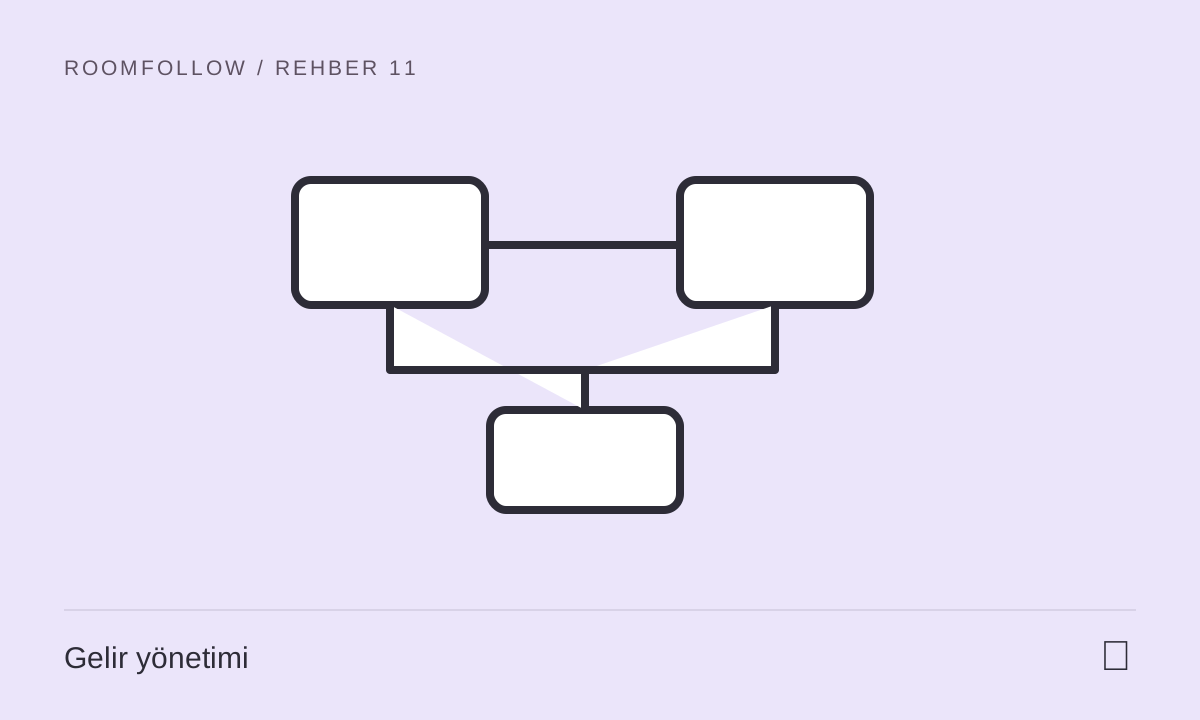
The fullness rate does not describe the sales performance of the ADR and RevPAR in the same way. The fullness rate shows how many rooms are sold, the average price obtained from the rooms sold, and the RevPAR shows the room income per room that can be sold. Reading these three data together makes it possible to understand whether a intense day seems really profitable.
- Compliance alone is not a success measure; a low-cost hotel may not produce expected income.
- RevPAR meets availability and ADR in the same indicator; but it does not include channel costs and additional revenue.
- What makes the report meaningful is not the one-day value, but the same period, segment and channel comparison.
What are the three indicators?
The fullness rate is found by the number of the rooms sold for the night to the number of the rooms sold for the night. If the rooms closed for sale due to maintenance enter the room account for sale, the hotel must be consistent in its own reporting rule. Otherwise it will be misleading to compare the rate of different days.
The average daily rate (ADR) is the division of room income into the room night sold, while RevPAR (Revenue per Available Room) divides room income into the room night sold, so RevPAR can also be seen as a match of ADR with availability: the availability rate is used in the decimal form, not in the percentage.
- Room for sale / Room for sale / Room for sale
- ADR = Room income / sale room night
- RevPAR = room income / available room night = ADR × filling
The same amount of money can result in different revenue.
Imagine 30 rooms are sold for a night in a hotel with 40 rooms available. the fullness is 75 percent. the room income is 90,000 TL and the ADR is 3,000 TL, the RevPAR is 2,250 TL. in another day, if you sell 30 rooms and get a total of 75,000 TL, the fullness will remain the same; the ADR is 2,500 TL, the RevPAR is 1,875 TL.
This difference may be due to a discount price plan, channel karma, group sale or room type distribution. So instead of leaving the question ‘Is the hotel full?’ you need to add the question ‘Which price and which channels it was full?’
Why does the ADR fall when the ADR rises?
A higher average rate does not always mean better RevPAR. For example, if ADR rises from TL 3,000 to TL 3,300 while occupancy falls from 80 percent to 65 percent, RevPAR falls from TL 2,400 to TL 2,145. The rate increase has not offset the lost room nights.
The price in the scenario can increase the RevPAR while the discount made to increase the fullness reduces the ADR. The decision is not based on the direction of a single number; the demand in the target date, instead of the competitive price, the hotel's own history, the remaining sale day and the distribution cost must be assessed together.
What breaks do you read?
The total hotel average can hide where the problem occurs. In the week and weekend, breakthroughs such as the room type, market segment, the date on which the reservation was created and the sales channel are more useful. For example, high ADR may only be formed because the share of the suites increased; the price behavior in the standard room has not changed.
Make the comparison also under similar conditions. The past year of the same week, the near-dated similar days or budget targets are good starting points. Removing, no-show, free room and non-service room records keep clear how to enter the report, makes it easier to investigate the source of differences.
- Type of room and type of pension
- Direct sales, OTA, agency and group such channels or segments
- Day of residence with the day of reservation
- Cancel, no-show, free and closed room moves for sale
A small example of a daily decision
Suppose that, seven days before Saturday, occupancy is 55 percent and ADR is TL 3,200. If last year's comparable dates show demand accelerating in the final three days, with higher-priced room types selling first, review the remaining room types and rate plans separately rather than discounting every room early.
In contrast, if the expected demand is not formed and the visibility of a specific channel is weak, a limited price plan or a change in the minimum accommodation rule can be tested. Follow the test result not only by the number of reservations, but by the net room income, ADR and RevPAR. Noting the start-end time of each change will allow you to understand which decision will affect later.
Connecting the RoomFollow report to the decision flow
The income metrics will not be reliable if the reception data is not up to date. The processing of the room type, price, stay date, cancellation and billing records in the same operating flow; it makes it easier to return to the source of a difference in the report. The monitoring of the room plan, reservation and operating records on the same hotel data in RoomFollow supports this control.
Instead of sharing a single total number in a weekly meeting, first open the availability-ADR-RevPAR summary; then examine the most obvious difference in the channel, room type or date breakthrough. So the report comes out of being a table that tells only the history and comes into the next sales decision.
The income management checklist will be applied every day
This short check is not for changing the price every day, but for a consistent assessment of whether it is necessary to change.
- For the next 7, 14 and 30 days, check the availability, ADR and RevPAR together.
- Compare last year’s results with a similar date or budget target.
- Check which high or low result comes from the room type, segment or channel.
- Verify that cancellation, no-show and non-service rooms are consistent with the metrics.
- See the room type with the highest demand with the number of rooms left.
- If the price or rule has been changed, record its scope, time and reason.
- In the next check, re-evaluate the results in the context of ADR, RevPAR and net income.
FAQ
What is the difference between ADR and RevPAR?
ADR only shows the average price of the rooms sold, while RevPAR also includes the availability effect, as it takes into account all the rooms available for sale.
Is high filling always good?
No. Compliance should be assessed along with the price and sales cost. Obtaining high compliance at very low price may not provide the target room income.
Are additional income included in the RevPAR calculation?
The classic RevPAR is based on room income; it does not include restaurant, spa or other additional income. The estimation of these income should also be used a defined total income metric.